Your well pump may be bad if you have no water, weak water pressure, air sputtering from faucets, dirty or cloudy water, a pump that runs constantly, a pressure switch that clicks repeatedly, or a breaker that keeps tripping.
That is the quick answer.
You can safely check a few basic things before calling a professional, such as the breaker, pressure gauge, pressure tank, visible leaks, and whether the issue affects one faucet or the whole house. However, well pump repair can involve electricity, pressure systems, underground lines, and equipment inside the well. If the pump needs electrical testing, removal, replacement, or deeper diagnostics, it is best to call a professional.
For New Hampshire homeowners, Mountain Plumbing provides well pump work for homes that rely on private well systems.
Quick Answer: How Do I Know If My Well Pump Is Bad?
Here are common signs that your well pump or well system may need service:
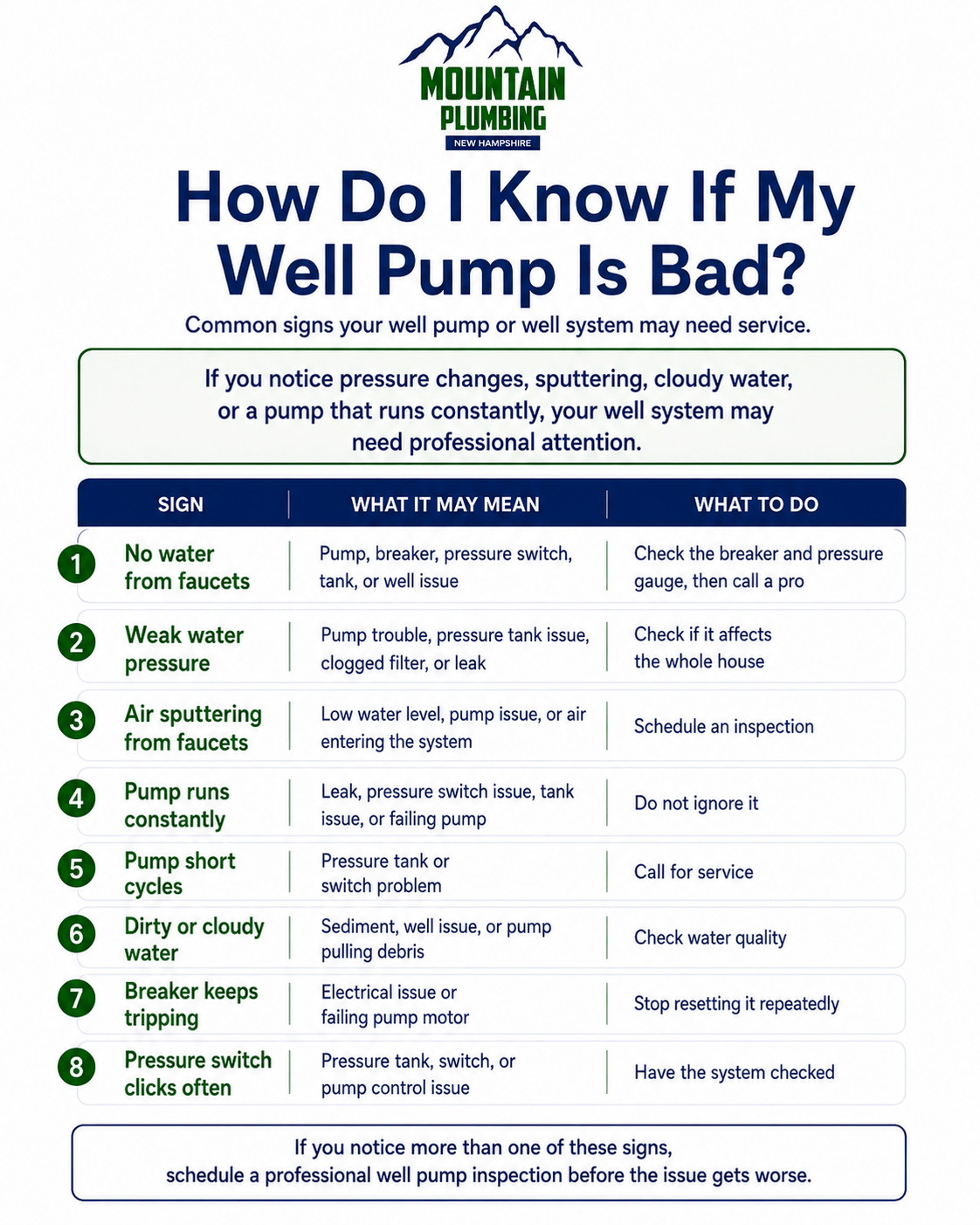
A private well system can include the pump, pressure tank, pressure switch, control box, pipes, wiring, and water treatment equipment. One symptom may have several possible causes, so the goal is to narrow down the issue safely before taking action.
Common Signs of a Bad Well Pump
A well pump rarely fails without warning. Many systems show symptoms before the water stops completely.
No Water From Faucets
No water is one of the most urgent well pump problems.
Possible causes include:
- Tripped breaker
- Failed pressure switch
- Bad pressure tank
- Pump motor failure
- Control box issue
- Broken wire
- Low well water level
- Damaged underground line
- Frozen pipe
- Failed pump
Start by checking whether the issue affects the entire home. If all faucets have no water, the problem may be with the well pump system rather than one fixture.
If the breaker has tripped, you can reset it once. If it trips again, stop. Repeated tripping can point to a serious electrical issue or failing pump motor.
Weak Water Pressure
Weak water pressure can come from the well pump, but it can also come from other parts of the system.
Possible causes include:
- Pressure tank issue
- Pressure switch problem
- Clogged filter
- Sediment buildup
- Pipe leak
- Failing pump
- Low well yield
- Water treatment system restriction
Low pressure may affect the whole home or only certain fixtures. If only one faucet is affected, the fixture may be clogged. If the whole home has weak pressure, the well system should be checked.
The pressure switch is an important part of the system because it tells the pump when to turn on and off based on pressure levels in the pressure tank. Nebraska Extension explains that the pressure switch starts the pump when system pressure drops to a set point, often 30 or 40 psi, and stops it when pressure reaches the cut-out level, often about 20 psi higher.
Air Sputtering From Faucets
If faucets spit air before water flows, air may be entering the plumbing system.
This can happen because of:
- Low well water level
- Failing pump
- Damaged drop pipe
- Leak in the well line
- Pressure tank issue
- Pump drawing air
A little sputtering after plumbing work may be normal. Repeated sputtering is different. If air keeps coming from faucets, the system should be inspected.
Pump Runs Constantly
A well pump that runs all the time is a warning sign.
It may be caused by:
- A leak in the plumbing system
- A leak in the well line
- Bad pressure switch
- Failed pressure tank
- Incorrect pressure settings
- Failing pump
- Low water level in the well
A pump that never shuts off can wear out quickly. It may also increase electricity use and lead to bigger repair costs.
Pump Short Cycles
Short cycling means the pump turns on and off too frequently.
This may happen when the pressure tank cannot hold pressure properly, the pressure switch is failing, or the system has another control issue.
Short cycling puts extra stress on the pump motor. It should be checked before it damages the pump.
Dirty, Cloudy, or Sandy Water
Dirty or sandy water can be a sign of well or pump trouble.
Possible causes include:
- Sediment entering the well
- Pump set too low
- Failing well screen
- Disturbed well sediment
- Water quality issue
- Aging well components
If dirty water continues, avoid guessing. The issue may involve the well, pump, filtration system, or water quality. Mountain Plumbing also provides water filtration services for homes dealing with water quality concerns.
How to Check a Well Pump Before Calling a Pro
If you are wondering how to check a well pump, start with simple, safe checks.
1. Check Whether the Whole House Is Affected
Turn on several faucets.
If only one fixture has a problem, the issue may be local to that faucet, shower, or appliance.
If the entire home has no water or low pressure, the well pump system may be involved.
2. Check the Breaker
Find the breaker labelled for the well pump.
If it has tripped, reset it once. If it trips again, stop and call a professional.
Do not keep resetting the breaker. A repeatedly tripping breaker may point to a wiring issue, pump motor problem, or electrical fault.
3. Check the Pressure Gauge
Look at the pressure gauge near the pressure tank.
A typical residential pressure system may turn the pump on at a lower pressure and shut it off at a higher pressure. The exact settings vary by system.
If the gauge is at zero, the pump may not be turning on, the tank may not be pressurised, or there may be a major issue.
If the gauge does not move when water runs, the pressure switch, gauge, tank, or pump may need inspection.
4. Listen for the Pump
If your pump is above ground, you may hear it turn on when water pressure drops.
For submersible pumps, you may not hear much directly, but you may hear the pressure switch click.
Repeated clicking, humming, or no response can all point to different problems.
5. Look for Visible Leaks
Check around the pressure tank, pipes, valves, water treatment equipment, and any visible well lines.
A leak can cause pressure loss and make the pump run more often than it should.
If you suspect a hidden plumbing leak, Mountain Plumbing also provides water leak detection services.
How to Test a Well Pump Without Pulling It
Many people search for how to test a well pump without pulling it because they want to avoid removing equipment from the well.
That makes sense. Pulling a pump can be complex and should usually be handled by a professional.
Before pump removal is considered, several checks can help narrow down the issue.
Check the Power Supply
Confirm whether the breaker is on and whether the system appears to have power.
If the breaker trips again after one reset, stop. Electrical problems need professional attention.
Check the Pressure Gauge
Watch what happens to the pressure gauge when water is running.
If pressure drops and the pump does not turn on, the issue may be the pressure switch, control box, wiring, or pump.
If pressure rises slowly or never reaches the normal shutoff point, the pump may be struggling, or there may be a leak or pressure tank issue.
Watch the Pump Cycling Pattern
A healthy system should turn on and off in a controlled way as water is used and pressure changes.
Warning signs include:
- Rapid clicking
- Pump running nonstop
- Pump not starting
- Pump starting then quickly stopping
- Pressure rising and falling too fast
Check for Air or Sediment
Air sputtering, cloudy water, or sand can point to a problem with the well, pump depth, drop pipe, water level, or well screen.
These are not issues to ignore because they can damage fixtures and equipment.
Check the Pressure Tank
The pressure tank helps regulate water pressure and reduce pump cycling.
If the tank is waterlogged or failing, the pump may turn on and off too often. This can make it seem like the pump is bad when the tank is part of the problem.
A professional can test the tank and confirm whether the issue is the tank, switch, pump, or another component.
How to Test a Pressure Switch on a Well
The pressure switch controls when the pump turns on and off. It is one of the most common parts to inspect when a well pump is not working correctly.
A pressure switch problem may cause:
- No water
- Pump will not start
- Pump will not stop
- Short cycling
- Rapid clicking
- Irregular pressure
- Pressure that does not reach normal levels
A homeowner can observe how the switch behaves, but electrical testing should be handled carefully.
Do not touch exposed wiring. Do not remove covers or test electrical contacts unless you are qualified.
A professional may check:
- Whether the switch is receiving power
- Whether contacts are burned or corroded
- Whether the switch activates at the correct pressure
- Whether the small pipe to the switch is clogged
- Whether the pressure gauge reading matches system behaviour
- Whether replacement is needed
Pressure switch symptoms can look similar to pump or pressure tank problems, so diagnosis matters.
How to Repair a Well Pump
If you are searching for how to repair a well pump or how to repair a well water pump, it is important to know that the repair depends on the actual cause.
A “bad pump” may not always be the pump itself.
Well pump repair may involve:
- Replacing a pressure switch
- Repairing a control box
- Fixing wiring
- Replacing a pressure tank
- Repairing a leaking well line
- Replacing a check valve
- Repairing or replacing the pump
- Addressing sediment or water quality issues
- Checking the well’s water level
- Correcting pipe or fitting problems
Some of these repairs are relatively straightforward for a trained technician. Others may require pulling the pump from the well.
Because well systems involve water, electricity, pressure, and underground components, professional diagnosis is the safest approach.
Can You Remove a Well Pump Yourself?
People often ask how to remove a well pump when they suspect the pump has failed.
In most cases, removing a well pump should be left to a professional.
Pump removal can involve:
- Electrical wiring
- Heavy pipe
- Deep wells
- Pitless adapter connections
- Drop pipe damage risk
- Contamination risk
- Pump cable damage
- Special equipment
- Risk of dropping the pump into the well
Submersible pumps may be deep underground, and pulling one without the right tools can lead to expensive damage.
A professional can test the system first to confirm whether the pump actually needs removal. That can help avoid unnecessary work.
Does Homeowners Insurance Cover Well Pump Repair?
Homeowners insurance coverage for well pump repair depends on your policy and what caused the damage.
In many cases, normal wear and tear, age, lack of maintenance, or gradual failure may not be covered. Sudden damage from a covered event may be handled differently, depending on the policy.
Because coverage varies, the best step is to review your policy or contact your insurance provider directly.
When speaking with your insurer, ask:
- Is the well pump covered?
- Is the pressure tank covered?
- Are underground lines covered?
- Is equipment breakdown covered?
- Does the cause of failure affect coverage?
- Is there a deductible?
- Are service records needed?
Mountain Plumbing can inspect the issue, but your insurance provider will determine coverage.
Well Pump Repair vs. Replacement
Repair may make sense if the issue is limited to a pressure switch, control box, wiring, pressure tank, valve, or visible plumbing component.
Replacement may be needed if the pump has failed, the motor is damaged, the pump is old, or repair is not practical.
Repair May Be Enough If:
- The pressure switch is faulty
- The pressure tank is the issue
- A control box component failed
- There is a small leak in accessible piping
- Wiring can be safely repaired
- The pump itself is still working
Replacement May Be Better If:
- The pump motor has failed
- The pump is old and unreliable
- The pump cannot maintain pressure
- The pump has been damaged by sediment
- The pump must be pulled and major repair is not cost-effective
- Repairs keep happening
- The system no longer meets household water demand
A professional can test the system and recommend whether repair or replacement makes more sense.
How to Prevent Well Pump Problems
You cannot prevent every well pump issue, but regular attention can reduce surprise failures.
Helpful steps include:
- Watch water pressure changes
- Listen for short cycling
- Pay attention to air sputtering
- Check for leaks near the pressure tank
- Protect pipes from freezing
- Keep the well cap secure
- Address dirty or sandy water quickly
- Schedule service when performance changes
- Maintain water filtration equipment
- Do not ignore repeated breaker trips
EPA guidance for small water systems emphasises preventive maintenance and routine operational checks to reduce system problems over time.
When to Call Mountain Plumbing for Well Pump Work
Call a professional if:
- You have no water
- Water pressure suddenly drops
- The pump runs constantly
- The pump short cycles
- The pressure switch clicks repeatedly
- The breaker keeps tripping
- Water is dirty, cloudy, or sandy
- You hear unusual pump or tank noises
- You suspect a well line leak
- You need the pump tested
- You think the pump may need removal
- You are unsure whether the issue is the pump, tank, switch, or plumbing
Mountain Plumbing provides plumbing services in New Hampshire for homeowners who need help with well pump and plumbing issues.
Need Well Pump Service in New Hampshire?
If your well pump is not working, your pressure is weak, or you are unsure what is causing your water problem, Mountain Plumbing can help.
Our team provides well pump support for homes across New Hampshire. We can inspect the system, check the likely cause, and recommend the right next step.
Whether you need help with pressure issues, pump testing, well pump repair, pressure switch problems, or possible replacement, our team can help.
Contact Mountain Plumbing today to schedule well pump service.
FAQs About Well Pump Problems
How do I know if my well pump is bad?
How do I know if my well pump is bad?
Your well pump may be bad if you have no water, weak water pressure, air sputtering, a pump that runs constantly, short cycling, dirty water, or a breaker that keeps tripping. However, pressure tank, switch, wiring, or plumbing issues can cause similar symptoms.
How do I test a well pump?
How do I test a well pump?
You can check the breaker, pressure gauge, pressure tank, pump cycling pattern, and whether the whole house is affected. Electrical testing and pump diagnostics should be handled by a professional.
How do I test a well pump without pulling it?
How do I test a well pump without pulling it?
You can observe the pressure gauge, check the breaker, listen for pump cycling, look for leaks, and check pressure switch behaviour. A professional can perform deeper testing before deciding whether the pump needs to be pulled.
How do I check a well pump?
How do I check a well pump?
Start by checking whether the issue affects the whole home, then check the breaker, pressure gauge, visible leaks, pressure tank, and pump cycling. If the issue continues, call a professional.
How do I test a pressure switch on a well?
How do I test a pressure switch on a well?
You can observe whether the switch clicks as pressure changes, but do not touch exposed wiring. A technician can safely test power, contacts, pressure settings, and whether the switch needs replacement.
How do I repair a well pump?
How do I repair a well pump?
Well pump repair depends on the cause. It may involve the pressure switch, pressure tank, wiring, control box, well line, valve, or pump itself. Professional diagnosis is recommended before repair.
Can I remove a well pump myself?
Can I remove a well pump myself?
It is not recommended. Removing a well pump can involve electrical wiring, heavy pipe, deep wells, contamination risk, and special equipment. A professional should test the system first and remove the pump if needed.
Does homeowners insurance cover well pump repair?
Does homeowners insurance cover well pump repair?
It depends on your policy and the cause of damage. Normal wear and tear or age may not be covered, while sudden covered events may be treated differently. Contact your insurance provider for policy-specific guidance.